
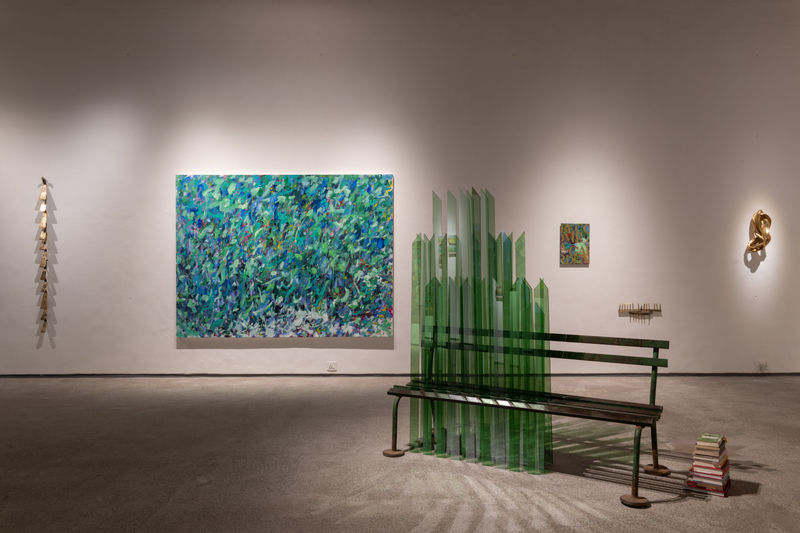
The weed appears quietly throughout this exhibition. Both an interloper and a resilient being, it regrows even when uprooted, thriving wherever it finds space. For the artist, the weed echoes a life that exists without fixed ownership, much like her own nomadic shepherd ancestry.
This body of work draws from the artist’s interactions with her grandfather, a mali who worked among the grand gardens of Lutyens’ Delhi. He cared for and nurtured countless plants and trees, yet he never once wished to claim a garden or a piece of land for himself. Plants were valued as individual entities for their medicinal, shade-giving and aromatic qualities. All living things, including weeds, were worthy of attention. Gardening, for him, was not about control but about nurturing, reflecting a deep respect for the land’s generosity.
Each painting in the exhibition begins with a landscape. As the work develops, layers of colour, gesture and marks gradually transform the scene into dense fields of vegetation where seeds, stems and drifting forms multiply across the canvas. Within these layered surfaces, the artist writes fragments of poems - sometimes clearly visible, sometimes partially buried beneath paint. These poems, many of which reflect on weeds and wandering seeds, move through the paintings like quiet thoughts embedded in the landscape.
I will grow back, for
I am a wind-blown seed.
This irrepressible weed quietly enters the works on display, transforming scenic gardens into landscapes that appear chaotic yet remain vibrantly alive. Sculptures reflect the labour of the gardener: clay once held in a gardener’s hands is cast in brass; rusted spades, dried seeds, twigs and fruits are preserved in metal, echoing the silent presence of botanical life around us.
Together, the works invite us to look beyond the comfort of the picturesque and recognise the displacement often hidden beneath beauty. They ask us to value a garden’s abundance without claiming ownership - to see the earth as something shared rather than possessed.
